
TPLO FAQ
Frequently Asked Questions
Does my dog really need surgery?
Not every dog with a cranial cruciate ligament rupture necessarily requires surgery. The best treatment depends on several factors, including your dog’s size, age, activity level, degree of knee instability and any other health concerns.
Without surgery, the knee may gradually become more stable as the joint capsule and surrounding tissues thicken and develop scar tissue. However, this process takes time, and the abnormal movement within the knee can continue to cause pain and damage to the joint.
Ongoing instability can contribute to meniscal injury and the development or progression of osteoarthritis. It can also mean a prolonged period of reduced activity and lameness.
For dogs where surgery is recommended, TPLO changes the biomechanics of the knee so that it no longer relies on the damaged cranial cruciate ligament for stability when the dog bears weight. This allows most dogs to return to comfortable, active use of the leg.
Will my dog be sore or groggy after the operation?
TPLO is a significant orthopaedic procedure, so effective pain relief is one of our highest priorities.
We use several different forms of pain relief together. This may include an epidural and continuous intravenous pain relief during surgery, followed by appropriate pain-relieving and anti-inflammatory medication during recovery and at home.
It is normal for dogs to be a little sleepy or groggy on the evening of surgery. Most are considerably brighter and more like themselves by the following morning.
Some discomfort is expected during the early recovery period, but your dog should not be significantly distressed or unable to settle. If you are concerned about their comfort at any stage, please contact us. We would much rather you call if you are unsure.
How long is the recovery? Does my dog need crate rest?
The bone usually requires approximately 8 weeks to heal adequately following TPLO. During this period it is very important to prevent running, jumping, slipping and rough play.
However, this does not mean eight weeks of continuous crate rest! Controlled movement is an important part of rehabilitation and helps maintain joint mobility, rebuild muscle and encourage a return to normal function.
The first 2 weeks: Your dog should be kept indoors in a small, controlled area. Lead walks are initially limited to toileting, and we will give you some gentle exercises to perform at home.
Weeks 2–8: Once the incision has healed and your dog has been reassessed, controlled lead walking can gradually increase. A typical starting point is around 5–10 minutes twice daily, increasing gradually as your dog progresses.
Every dog recovers at a slightly different rate, so we will adjust the rehabilitation plan according to your dog’s comfort, strength and progress.
How soon will my dog use the leg after surgery?
Most dogs will begin putting some weight on the operated leg within the first few days after surgery, and some will start using it surprisingly quickly.
Don’t worry if your dog is initially a little cautious with the leg. They have just had major knee surgery, so some stiffness and reluctance to fully weight-bear is completely understandable.
You should notice the use of the leg gradually improving and most dogs are walking with just a slight limp by 3 weeks after surgery.
Will my dog be able to run and play normally again?
For most dogs, yes — that’s the goal!
Once the bone has healed and your dog has rebuilt their strength and fitness, most dogs can gradually return to the activities they enjoyed before their cruciate injury. This may include longer walks, running, playing, swimming and generally getting back to being a dog again.
How do I prepare my home for my dog’s recovery?
A little preparation before surgery can make the first few weeks at home much easier for both you and your dog.
Set up a small, comfortable recovery area where your dog can rest safely without being able to run, jump or race around the house. This might be a small room, playpen or sectioned-off area.
Slippery floors can be particularly difficult after knee surgery, so place non-slip mats, rugs or runners over tiles, floorboards and other slippery surfaces your dog needs to cross.
Try to avoid stairs wherever possible, and use baby gates or other barriers to prevent unsupervised access. Your dog should also be prevented from jumping on and off beds, couches or into the car during the healing period.
Make sure food and water are easily accessible and provide a comfortable bed with plenty of room for your dog to lie down and get up safely.
For the first few weeks, life will be a little quieter than usual — but it doesn’t have to be boring! Food puzzles, enrichment toys and plenty of attention can help keep your dog entertained while their exercise is restricted.
And don’t worry — we will give you detailed instructions before your dog goes home, so you won’t be left trying to work it all out on your own
How successful is TPLO surgery?
The outlook following TPLO surgery is generally excellent. Clinical studies consistently show that more than 90% of dogs return to normal or near-normal activity levels following TPLO surgery, making it one of the most successful orthopaedic surgeries in dogs.
As with any surgery, we cannot guarantee a perfect outcome. Results can be influenced by factors such as your dog’s age, weight, degree of arthritis, meniscal damage and how closely the post-operative rehabilitation plan is followed.
Is TPLO safe?
TPLO is a major orthopaedic procedure, and no surgery is completely without risk. However, it is a well-established technique that has been performed successfully in dogs for over 30 years.
Careful surgical planning, meticulous surgical technique, appropriate implants, modern anaesthesia and good post-operative care all contribute to reducing the risk of complications.
We will discuss the potential risks with you before surgery so that you can make an informed decision about your dog’s treatment.
How do you know exactly where to cut the bone?
Careful planning is an essential part of every TPLO.
We use a specialised veterinary surgical planning software called V-Pop. Your dog’s X-rays are calibrated within the program so that we can take precise measurements of their individual anatomy.
We calculate the slope at the top of the tibia (tibial plateau angle), select the appropriate saw size, determine exactly where the bone cut should be positioned, and calculate how far the bone segment needs to be rotated. We can even overlay different TPLO plates onto the X-ray to determine which implant will provide the best fit.
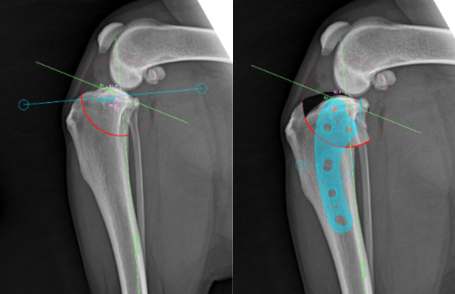
This means much of the precision work involved in a TPLO has already been carefully planned before we enter the operating theatre.
It is a pretty clever piece of technology!
What are the possible complications?
As with any surgery, TPLO has potential complications. These can include infection, delayed bone healing, implant-related problems such as screw loosening or breakage, meniscal injury and, less commonly, fracture or other complications requiring further treatment.
Serious complications are uncommon, but it is important to understand that no surgical procedure is completely risk-free.
There are also risks associated with general anaesthesia. During your dog’s procedure, our team continuously monitors parameters including blood pressure, ECG, oxygen levels, carbon dioxide levels and body temperature. This allows us to identify and respond quickly to any changes.
Your dog continues to be closely monitored throughout recovery to ensure they remain safe and comfortable.
Will the plate and screws need to be removed?
Usually, no.
The TPLO plate and screws are designed to remain in place permanently once the bone has healed. Most dogs are completely unaware that they are there and the implants do not cause any problems.
Occasionally, a plate may need to be removed if it becomes associated with infection, irritation or another implant-related complication. However, routine removal of the plate and screws is not necessary.
Can the meniscus still tear after TPLO surgery?
Yes. Although TPLO greatly improves the stability of the knee, a late meniscal tear can still occur in a small percentage of dogs following TPLO. Most studies have found this to be around 5%. This rate of meniscal damage is of course substantially less that in an unstable knee with no surgery.
Signs can include a sudden increase in lameness after your dog had previously been recovering well, sometimes accompanied by a clicking sound from the knee.
If this occurs, it may mean another surgery to trim the torn meniscus. However, this time it is a much shorter procedure with a faster recovery time.
Will my dog still develop arthritis after TPLO?
TPLO stabilises the knee, but unfortunately it cannot reverse arthritis that has already developed as a result of cruciate disease. Some progression of osteoarthritis can still occur over time, even following successful surgery.
Our aim is not to make the knee exactly as it was before the cruciate ligament became damaged. Instead, we aim to create a stable, comfortable and functional knee that allows your dog to return to a good quality of life.
Maintaining a healthy body weight, regular appropriate exercise and good muscle strength are also important for supporting the joint in the longer term.
Can older dogs have TPLO surgery?
Absolutely. Age alone is not a reason that a dog cannot have TPLO surgery.
We are much more interested in your dog’s overall health, mobility and quality of life than the number of candles on their birthday cake!
Before surgery, we assess your dog carefully and perform appropriate pre-anaesthetic testing. If there are other health concerns, we may recommend additional investigations or make adjustments to their anaesthetic and treatment plan.
Older dogs can still be active dogs, and many senior dogs benefit enormously from having a painful, unstable knee made comfortable again.
Recovery and rehabilitation can be tailored to suit your dog’s individual fitness, strength and any other conditions such as arthritis in other joints.
What are the chances my dog will rupture the cruciate ligament in the other knee?
Unfortunately, dogs that develop cruciate disease in one knee have an increased risk of developing the same problem in the opposite knee.
Studies suggest that around 40–50% of affected dogs may eventually develop cruciate disease in the other knee, although the risk varies between dogs.
This is because canine cruciate disease is usually a degenerative process, rather than simply the result of a one-off injury. Genetics, body weight, conformation and individual knee anatomy may all play a role.
There is no way to predict with certainty if or when the opposite knee will be affected.
What rehabilitation is available after surgery?
Rehabilitation is an important part of achieving the best possible result after TPLO.
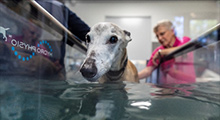
At Pet Universe, we have nurses with extensive rehabilitation training as well as a dedicated rehabilitation facility. Depending on your dog’s individual needs, their program may include underwater treadmill therapy, therapeutic laser, therapeutic ultrasound, electrical stimulation and targeted strengthening exercises.
The aim isn’t simply to allow the bone to heal — it is to help your dog regain muscle strength, joint movement, confidence and normal use of the leg.